How Earth's Magnetic Field Shapes the Radiation Environment
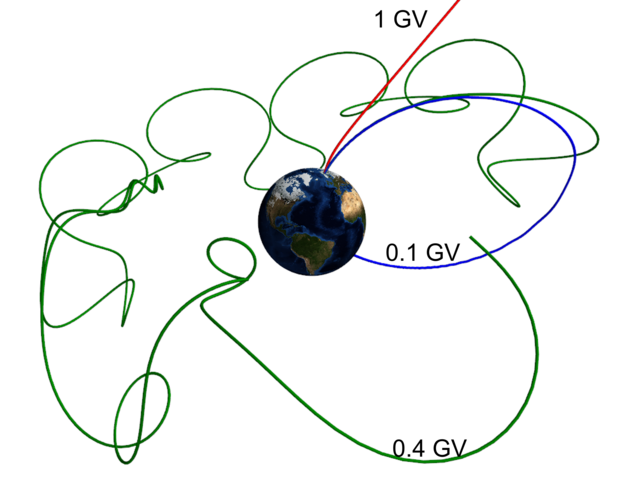
Earth is continuously exposed to energetic particles from space. Galactic cosmic rays originate beyond the Solar System, while solar energetic particles are produced during powerful eruptions on the Sun. Before reaching the Earth's atmosphere, these charged particles must pass through the geomagnetic field, which acts as a natural shield. Under present-day conditions, it prevents many lower-energy particles from reaching the atmosphere, while allowing higher-energy particles to penetrate more easily, particularly at high latitudes.
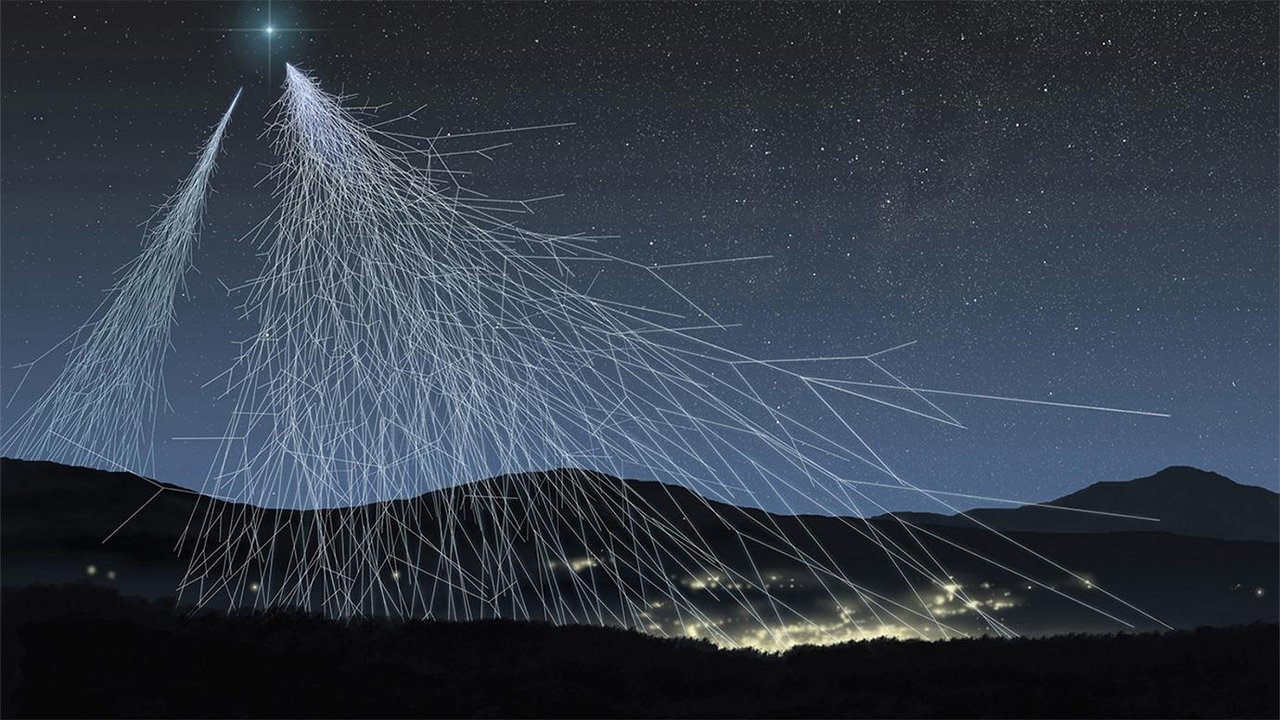
When energetic particles enter the atmosphere, they collide with atmospheric molecules and generate cascades of secondary particles. These cascades produce ionisation and contribute to the radiation environment from the upper atmosphere down to aviation altitudes and, for sufficiently energetic particles, even to the Earth's surface. The intensity and geographical distribution of this radiation therefore depend not only on solar and cosmic-ray activity, but also strongly on the strength and geometry of the Earth's magnetic field.
During geomagnetic excursions and reversals, the situation may be very different. The dominant dipole component of the field can become much weaker, while complex non-dipolar structures become relatively more important. As a result, the effectiveness and geographical pattern of geomagnetic shielding may change dramatically, allowing energetic particles to access regions that are normally well protected. Such unusual magnetic configurations may also fundamentally alter the trapping and transport of energetic particles within the magnetosphere, raising questions about the structure of radiation belts comparable to today's Van Allen belts.
Our contribution to GERACLE
In GERACLE, the team at the University of Oulu, led by Prof. Ilya Usoskin, will investigate the Earth's radiation environment under the unusual geomagnetic conditions associated with excursions and reversals. Drawing on the team's expertise in cosmic rays, energetic particles, geomagnetic shielding and atmospheric particle cascades, the researchers will address key questions including:
1. How does the access of solar energetic particles to the Earth change when the geomagnetic field becomes weak and strongly non-dipolar?
2. How do these changes affect the geographical distribution and intensity of the radiation field?
3. Can stable populations of trapped energetic particles and radiation belts comparable to the present-day Van Allen belts exist under such unusual geomagnetic conditions?
4. How severe could the radiation effects of extreme solar particle events become when geomagnetic shielding is substantially reduced?