How the Sun Shapes Earth's Space Environment
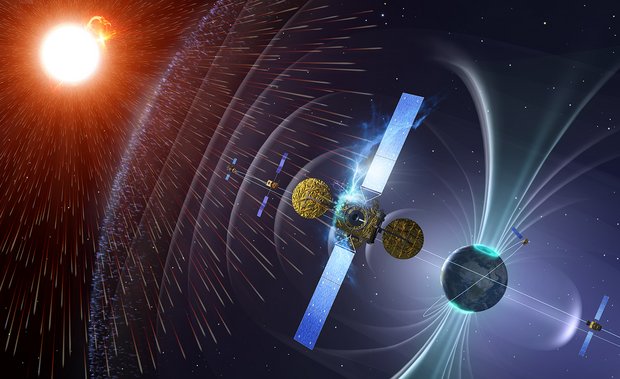
The Sun influences the Earth through electromagnetic radiation, energetic particles, the solar wind, and solar eruptions. The solar wind is a continuous outflow of ionised gas, known as plasma, that is structured into slow and fast streams separated by stream interaction regions. The principal forms of solar eruptions are flares and coronal mass ejections (CMEs). Flares are sudden releases of energy comparable to millions of hydrogen bombs, while CMEs are expulsions of billion of tons of magnetised plasma into interplanetary space at speeds up to several thousand kilometres per second. Together, flares and shock waves driven by fast CMEs accelerate charged particles to high energies, producing solar energetic particle (SEP) events.
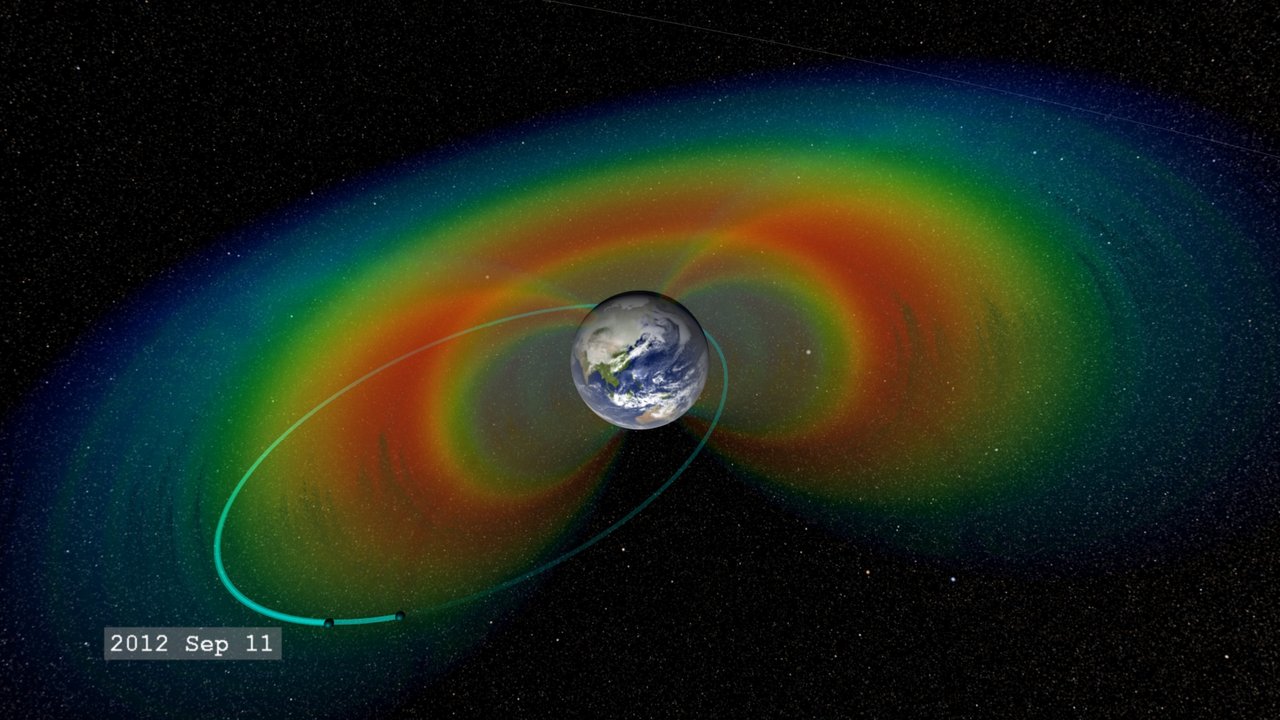
These phenomena disturb the heliosphere and drive space weather in near-Earth space, producing strong variations in the geomagnetic field and plasma environment, changes in the Van Allen radiation belts, and rapid intensifications of magnetospheric and ionospheric current systems. High-energy particles from SEP events and from acceleration processes within Earth's magnetosphere can penetrate the upper atmosphere, modifying its composition and dynamics. Although these effects are relatively well established under present-day geomagnetic conditions, their consequences during geomagnetic reversals and excursions are largely unknown. For estimating consequences during the times when the Earth’s magnetic field changes, it is critical to understand the range of possible solar wind driving conditions.
Compared to timescales of reversals and excursions that last from hundreds to thousands of years, solar activity varies considerably more rapidly. The most prominent variation is the approximately 11-year variations in solar activity, known as the solar cycle. Evidence from indirect proxies shows that this cycle has persisted for several millennia, although periods of unusually low or high activity cycle may occur in a row, called the Grand Minima and the Grand Maxima. Modern space-age observations cover a limited range of solar variability. There is no direct observational evidence of heliospheric conditions during Grand Minima, nor of the most extreme solar eruptions that may occur over millennial timescales.
Our contribution to GERACLE
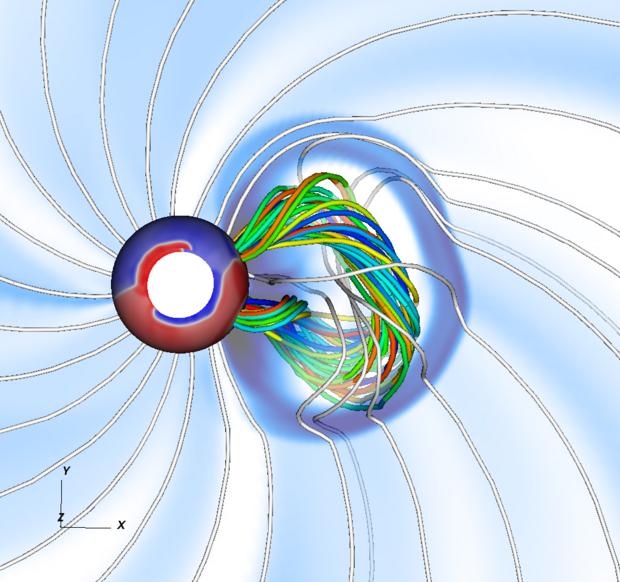
In GERACLE, the University of Helsinki team will conduct a range of simulation studies to model heliospheric conditions associated with both solar Grand Minima and Grand Maxima. These will provide realistic input parameters for magnetospheric models representing geomagnetic reversals and excursions. Our simulations will consist of solar atmosphere and heliospheric models driven by synthetic solar surface magnetic field maps (magnetograms). Key scientific questions include:
- How do the largest possible CMEs form and what are their properties?
- How can interactions between multiple eruptions enhance their geoeffectiveness?
- And how does the large-scale solar magnetic field generate the most powerful solar wind streams?
Further, the team will investigate the existence of Van Allen radiation belts and the scattering of trapped particles, which are key drivers of atmospheric impacts. It is expected that during periods of geomagnetic field change, solar eruptions and high-speed solar wind streams may produce stronger disturbances and effects than under present-day conditions.